

Temporary to Permanent Residency Australia: Skilled Worker Guide
Most skilled workers arrive in Australia on a temporary visa with the assumption that permanent residency will follow naturally. It does not. The transition from temporary to permanent residency Australia requires deliberate planning, correct employer alignment, and an understanding of how the points test, skills assessments, and nomination pathways actually interact. Miss one step and you can lose months or years of progress. This guide explains exactly how the pathways work, where applicants consistently make costly errors, and what the data says about approval rates across the most common skilled migration routes.
Table of Contents
- Why Temporary Visas Are Not a Guaranteed PR Path
- Subclass 482 to Permanent Residency: The TRT and Direct Entry Routes
- Skilled Independent and State Nomination Pathways for PR
- Comparison of PR Pathways for Skilled Workers
- The Points Test and Skills Assessment: What Actually Matters
- Regional Visas as a PR Strategy
- Common Mistakes That Delay or Derail PR Applications
- How TerraOz Migration Supports Your PR Transition
- Frequently Asked Questions
- References
Quick Takeaways
| Key Insight | Explanation |
|---|---|
| 482 holders have two PR routes | The Temporary Residence Transition (TRT) stream requires 2 years with one employer on 482 visa and total 3 years of related full-time work experience. The Direct Entry stream bypasses that but requires total 3 years of related full-time work experience and a fresh nomination and skills assessment. |
| Occupation lists change frequently | Your occupation must appear on the relevant CSOL list, when you lodge your 482 visa. |
| 65 points is the practical floor, not the target | In practice, 65 points rarely results in an invitation through SkillSelect in Skilled Visa pathway. Most invitations in recent rounds have gone to applicants scoring 90 or above in competitive occupations. |
| State nomination doubles your points | A successful state or territory nomination under subclass 190 adds 5 points. Under subclass 491 it adds 15 points, which can be decisive in competitive EOI pools. |
| Regional visas offer a faster PR bridge | Subclass 491 is a temporary regional visa, but it leads directly to subclass 191 PR after 3 years of regional living and working requirements are met. |
| Skills assessments expire | Most assessing bodies issue assessments valid for 2-3 years. If your assessment expires before you receive an invitation, you must reassess. Plan your timeline accordingly. |
| Employer sponsorship does not guarantee PR nomination | Holding a 482 visa does not obligate your employer to nominate you for PR. Clarify PR intentions with your employer before accepting the sponsorship offer. |
Why Temporary Visas Are Not a Guaranteed PR Path
Australia’s skilled migration system is deliberately structured in two stages. The government uses temporary visas to test whether a skilled worker contributes economically before granting permanent status. This is a policy choice, not an administrative formality, and it means the path from temporary to permanent residency is conditional at every step.
The subclass 482 Skills in Demand visa is the most common entry point for employer-sponsored skilled workers. However, holding a 482 visa gives you the right to work in Australia, not the right to apply for PR. Permanent residence must be earned separately, either through your employer nominating you for a subclass 186, through an independent skilled pathway, or through a regional route.
The Department of Home Affairs processes over 100,000 skilled visas annually across temporary and permanent categories. According to the Australian Department of Home Affairs migration program statistics, the employer-sponsored permanent visa category consistently receives more applicants than the government allocates places. In practical terms, this means competition is real and timing matters enormously.

Subclass 482 to Permanent Residency: The TRT and Direct Entry Routes
The subclass 186 Employer Nomination Scheme (ENS) visa is the standard permanent visa for employer-sponsored workers. It has two streams that are relevant to 482 holders, and choosing the wrong one is one of the most expensive mistakes a skilled worker can make.
Temporary Residence Transition Stream
The Temporary Residence Transition (TRT) stream is designed for workers who have already been in Australia on a 482 visa. To qualify, you must have worked for the same employer in the same nominated occupation for at least 2 years before applying. The occupation must still be on the eligible list, and you must hold a valid skills assessment in most cases depending on your occupation and assessing authority.
The advantage of TRT is that the points test does not apply. Your employer nominates you directly and, if the application is complete and genuine, approval rates are high. The disadvantage is the 2-year lock-in with one employer. If you change jobs, your TRT clock resets. Many workers do not discover this until after they have moved roles.
Direct Entry Stream
The Direct Entry stream of the 186 visa does not require prior time on a temporary visa in Australia. However, it requires a positive skills assessment, a job offer from an approved sponsor, and the applicant must generally have at least 3 years of relevant full-time work experience. This stream is often used by workers who change employers or whose occupation requires it.
In practice, the Direct Entry stream involves more documentation, and the skills assessment requirement adds both time and cost. Processing times for subclass 186 currently range from 12 to 18 months depending on the stream and individual circumstances according to the Department of Home Affairs processing time data.
Pro tip: If you are on a 482 visa and your employer has not mentioned PR nomination, raise it in writing before your second work anniversary. Waiting until month 35 of a 36-month requirement only to discover your employer will not nominate you is a situation TerraOz Migration has helped clients recover from, but it is far easier to plan ahead.
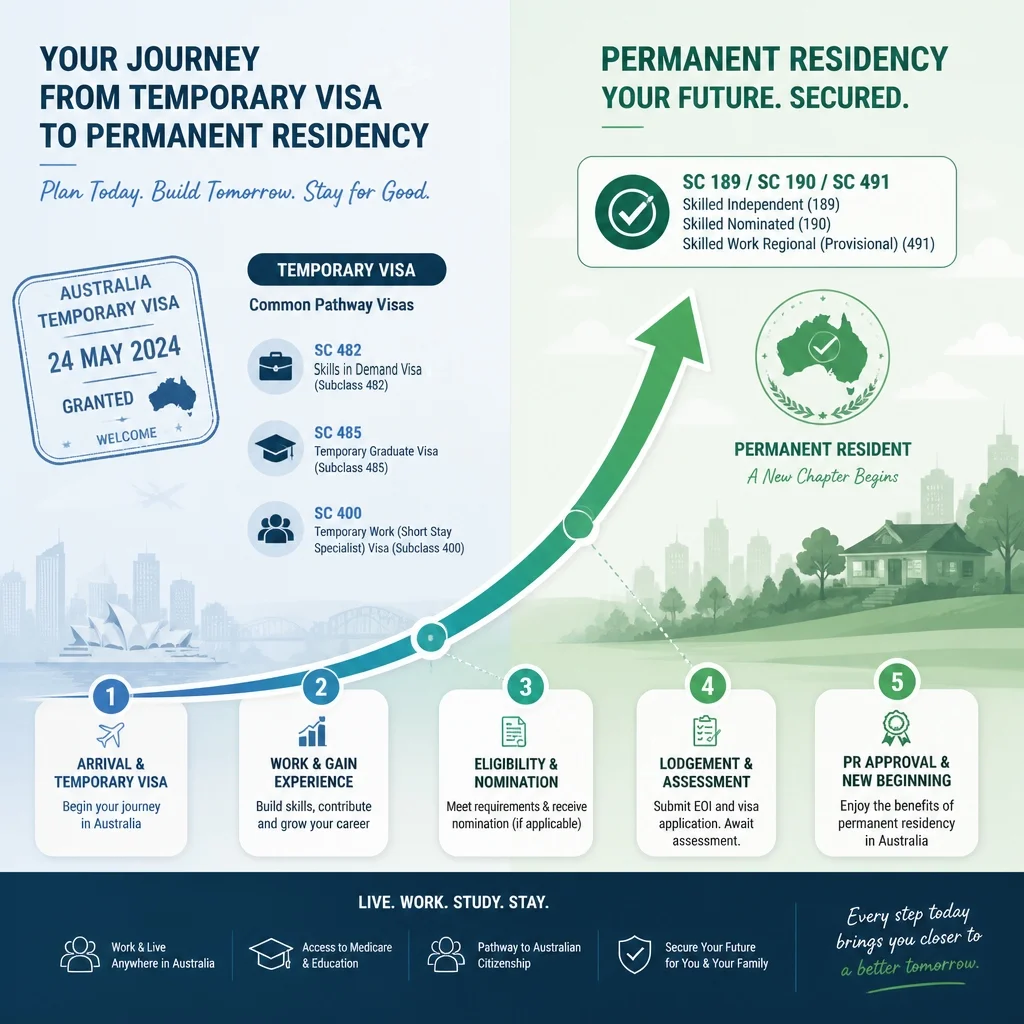
Skilled Independent and State Nomination Pathways for PR
Not every skilled worker in Australia has an employer willing to sponsor them for PR. For those individuals, the Australian PR pathway for skilled workers through SkillSelect is the primary alternative. This system manages expressions of interest (EOIs) for subclass 189 (Skilled Independent) and subclass 190 (Skilled Nominated) visas.
Subclass 189: Skilled Independent Visa
The subclass 189 visa grants permanent residency without requiring employer sponsorship or state nomination. You submit an EOI through SkillSelect, accumulate points, and wait for an invitation. The occupation must be on the Medium and Long-term Strategic Skills List (MLTSSL).
The reality is that the 189 visa is intensely competitive. In recent invitation rounds, occupations like software engineer and registered nurse have required scores of 90 or above to receive an invitation. Some occupations have not received any invitations at all for extended periods. Relying solely on the 189 pathway without a contingency plan is a high-risk approach.
Subclass 190: State Nominated Visa
The subclass 190 visa adds 5 points to your score but requires you to live and work in the nominating state or territory for at least 2 years after grant. Each state and territory publishes its own occupation list and nomination criteria, which change regularly based on local labour market needs.
A common mistake is assuming that because your occupation is on the federal MLTSSL, every state will nominate you. States maintain separate lists. Victoria, New South Wales, and Queensland each have distinct priorities and caps. Checking the correct state list and applying to multiple states where eligible is a smarter approach than focusing on one.
Pro tip: State nomination applications are assessed on a first-come, first-served or competitive basis depending on the state. Submitting a complete application matters more than submitting a rushed one. Incomplete state nominations are rejected without refund, and you typically cannot reapply until the next round opens.
Comparison of PR Pathways for Skilled Workers
| Pathway | Key Requirements | Best Suited For |
|---|---|---|
| Subclass 186 TRT Stream | 2 years with same employer on 482, nominated occupation, valid skills assessment (occupation-dependent) | Workers with stable long-term employer relationships who have confirmed PR nomination intent |
| Subclass 190 State Nominated | EOI in SkillSelect, state nomination, occupation on relevant state list, minimum 65 points (higher in practice) | Workers with competitive points scores whose occupation is prioritised by at least one state or territory |
| Subclass 491 to 191 Regional Pathway | State or family nomination, regional area employment and residence for 3 years - pathway to 191 | Workers willing to live regionally, those with lower points scores who cannot compete in major city draws |
The Points Test and Skills Assessment: What Actually Matters
The points test is the foundation of independent skilled migration, and understanding how points accumulate is not optional if you are serious about Australian PR. The test awards points across age, English language proficiency, skilled employment experience, education, and Australian study qualifications, among other factors.
Age is a factor that works against you the longer you wait. Applicants aged 25 to 32 receive the maximum 30 points for age. Points decline in steps from age 33 onward, and no points are available for applicants aged 45 or older. This means delaying your EOI submission by even 12 months can cost you 5 points in the age category alone.
“The skilled migration points test rewards those who act on their strongest competitive position, not those who wait for perfect conditions.” - Department of Home Affairs, SkillSelect guidance documentation
English language proficiency is the second highest scoring factor after age. A Superior English score (IELTS 8 or equivalent in all bands) awards 20 points. Proficient English (IELTS 7 in all bands) awards 10 points. The difference between proficient and superior English is 10 points. In a competitive pool where 5 points separates invited and uninvited applicants, that gap is decisive. Many applicants underinvest in English preparation and then wonder why they are not receiving invitations.
Skills assessments must be completed by the relevant assessing body for your occupation before you can submit an EOI. Engineering occupations go through Engineers Australia. Accountants use CPA Australia, CAANZ, or IPA depending on their specialty. Nurses are assessed by ANMAC. The assessment itself does not guarantee your skills match current Australian standards. Rejections and additional evidence requests are common, particularly for overseas qualifications that do not map cleanly to Australian frameworks.
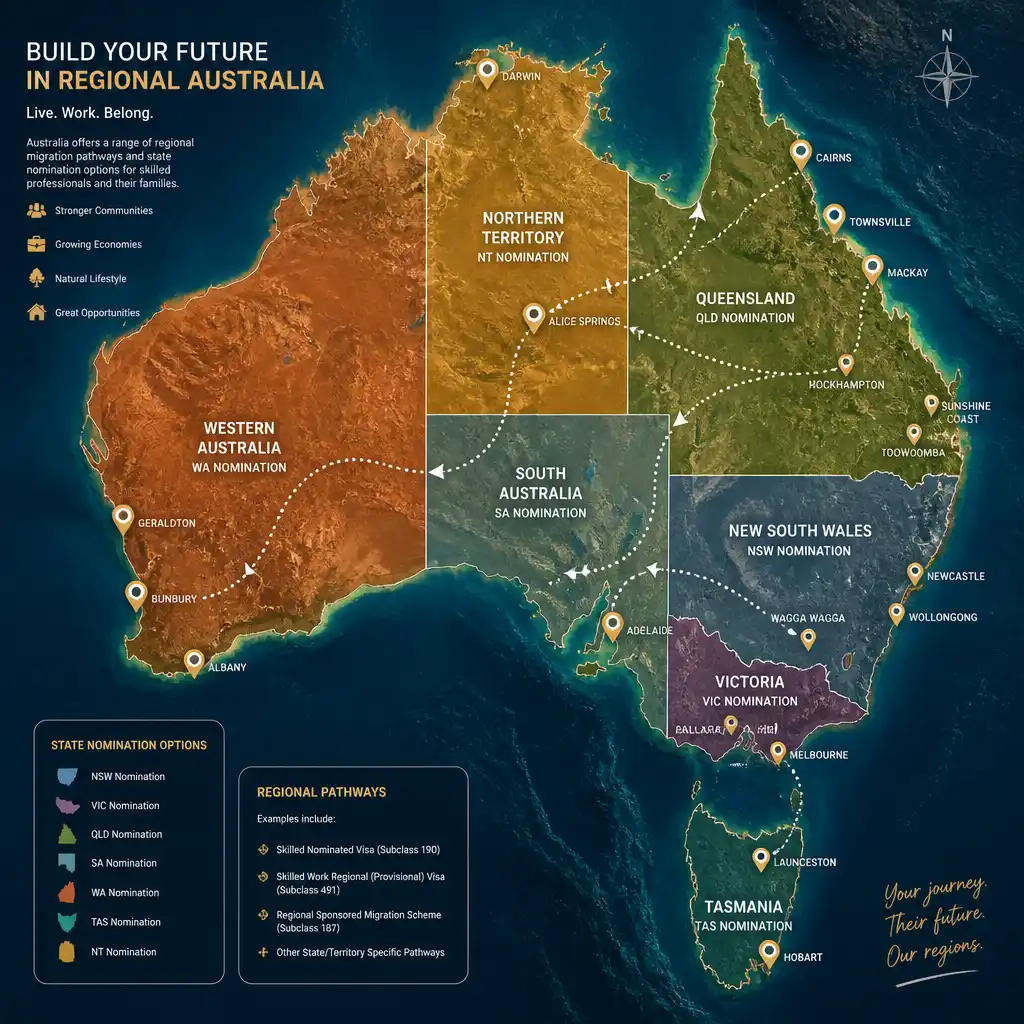
Regional Visas as a PR Strategy
The subclass 491 Skilled Work Regional (Provisional) visa is not a PR visa, but it is a structured pathway to one. After holding a 491 for at least 3 years, meeting the required living and working in a designated regional area, applicants can apply for the subclass 191 Permanent Residence (Skilled Regional) visa.
The strategic appeal of the regional pathway is points. The 491 visa adds 15 points to your EOI score, which makes it accessible to applicants who would not otherwise receive an invitation for a 189 or 190 visa. Workers in occupations on the Regional Occupation List who score 65 or 70 points can use the 491 as a realistic route to PR where the metropolitan pathway is effectively closed to them.
The commitment is real, though. Regional living means residing outside Sydney, Melbourne, and Brisbane in most cases. Many designated regional areas are large cities in their own right, including Wollongong, Geelong, Gold Coast, and Sunshine Coast. Others are genuinely remote. Before pursuing this pathway, workers should research specific regional areas and confirm the career opportunities available match their occupation and personal circumstances.
The data consistently shows that uptake of regional visas has grown significantly since the 491 replaced the 489 in 2019. According to the Department of Home Affairs annual migration program report, regional skilled visas have increased year-on-year as workers discover the points advantage makes PR achievable within a defined 3-year timeline rather than an open-ended wait in a competitive metropolitan EOI pool.
Common Mistakes That Delay or Derail PR Applications
In practice, the same errors appear repeatedly in failed or delayed PR transition applications. Identifying them here is more useful than generic advice about following the rules.
Failing to confirm employer PR nomination intent in writing. Many workers assume that a willing 482 sponsor will automatically nominate them for 186 when the 3-year period is up. Employers change ownership, restructure, or simply decide not to proceed. Get written confirmation of PR nomination plans before you structure your entire visa strategy around the TRT stream.
Occupations falling off eligible lists mid-pathway. Occupation lists are reviewed periodically. An occupation that qualifies for 186 TRT today may not qualify in 18 months. Workers in occupations that are being monitored for removal should have a parallel strategy in place. Waiting to see whether your occupation survives the next review is not a plan.
Letting skills assessments expire. Assessments issued by most bodies are valid for 2-3 years. If your EOI has not resulted in an invitation before your assessment expiry date, you need to apply for reassessment. Some bodies allow extensions. Others require a full new application. Factor this into your timeline from the moment you receive your initial assessment result.
Not updating your EOI after a skills assessment or English test improvement. An EOI is not a set-and-forget document. If your points score increases because you retook IELTS and moved from proficient to superior, update your EOI immediately. Invitations are based on your score at the time of the round draw, not at the time you submitted the EOI. Failing to update means you are being assessed on outdated data.
Misunderstanding the difference between temporary and permanent partner visa implications. For workers who have partners in Australia, the visa conditions and income contributions that count toward points and residency calculations can be affected by the partner’s visa type. This is a specific area where professional advice from a MARA-registered agent can prevent costly errors.
How TerraOz Migration Supports Your PR Transition
TerraOz Migration is a MARA-registered migration consultancy with over 20 years of experience and more than 1,000 approved visas across skilled, employer-sponsored, and family migration categories. MARA registration means TerraOz agents are legally qualified to provide immigration assistance and are accountable to the Office of the Migration Agents Registration Authority.
The value of working with a registered agent on a PR transition is not just paperwork management. It is strategic advice at the points where decisions have long-term consequences. Choosing between TRT and Direct Entry on a 186, deciding which states to approach for 190 nomination, determining whether the 491 regional pathway is worth pursuing given your occupation and family situation, these are decisions where the wrong call costs years.
TerraOz’s approach to permanent residency from skilled visa applications is end-to-end: initial assessment of your eligibility and points score, skills assessment coordination, EOI submission, state nomination applications, employer nomination coordination, and full visa lodgement and case management through to grant. With a 98% client satisfaction rate, the process is transparent and the advice is direct.
If you are currently on a 482 or 491 visa and are unsure which PR pathway applies to your situation, the single most useful action you can take is to book a professional consultation before your current visa expiry date forces a rushed decision. Visit TerraOz Migration to request an assessment from a MARA-registered agent who works specifically with skilled migration cases.
Frequently Asked Questions
Can I apply for permanent residency directly from a subclass 482 visa?
You cannot apply for PR directly on the basis of holding a 482 visa alone. You need to apply through a separate PR pathway such as the subclass 186 Employer Nomination Scheme via the Temporary Residence Transition stream (after 2 years with the same employer), or through an independent skilled pathway via SkillSelect if your occupation qualifies. The 482 is a stepping stone, not an automatic PR grant.
What is the minimum points score needed to get an invitation for a skilled visa?
The minimum points threshold to submit an EOI is 65. However, in practice, most invitations in recent SkillSelect rounds have gone to applicants with scores of 85 to 100 or above, depending on the occupation. Some occupations with high demand and limited places effectively require 90 or more. Check the latest round results published by the Department of Home Affairs to understand the competitive score for your specific occupation before setting expectations.
Does changing employers on a 482 visa affect my PR pathway?
Yes, significantly. If you are planning to use the Temporary Residence Transition stream of the subclass 186, changing employers resets your 2-year clock. You must work for your nominating employer for the full 2 years in the same nominated occupation. If you change employers, you would need to complete 2 years with the new employer before becoming eligible for TRT, or pursue the Direct Entry stream or an independent skilled pathway instead.
How long does it take to get permanent residency from a skilled visa in Australia?
Timelines vary by pathway. The subclass 186 TRT stream requires 3 years of employment before you can apply, then current processing times of approximately 12 to 18 months for the visa itself. The 189 and 190 pathways depend on your points score and how quickly you receive an invitation, which can range from immediate to several years in competitive occupations. The 491 to 191 regional route takes a minimum of 3 years of regional residence after grant of the 491 before you can apply for the 191. Planning for a 3 to 5 year timeline from arrival on a temporary visa to PR grant is realistic for most applicants.
What is the subclass 191 visa and who can apply?
The subclass 191 Permanent Residence (Skilled Regional) visa is the PR outcome of the regional migration pathway. It is open to holders of the subclass 491 who have lived and worked in a designated regional area for at least 3 years throughout that period. It was introduced in November 2022 and replaced the earlier subclass 887 for new applicants coming through the 491 route. It is not open to applicants who have not first held a 491 or certain legacy regional visas.
Is a skills assessment always required for the subclass 186 visa?
Not always. For the TRT stream of the subclass 186, a skills assessment is only required if specified by the relevant assessing body for your occupation. Many trade and professional occupations do require one. For some employer-sponsored occupations, the skills assessment requirement may be waived or already satisfied by your 482 application process. However, this depends entirely on the occupation and the assessing authority. Confirming this early avoids expensive surprises late in the application process. For DES stream, Skills Assessment is mandatory.
Can I include my family in a skilled PR visa application?
Yes. Most Australian skilled permanent visas allow you to include a partner and dependent children in the same application. They receive the same permanent residence status upon grant. The primary applicant must meet all the eligibility criteria, but family members are assessed for health and character requirements. Including dependents adds to the application fee and documentation requirements, but it is the most cost-effective approach compared to lodging separate applications later.
If you are currently navigating a temporary visa and weighing your options for Australian PR, share your experience or questions in the comments below. Your situation may help others in the same position.
References
- Australian Department of Home Affairs official immigration portal covering visa types, processing times, and skilled migration program statistics
- Australian Bureau of Statistics data on migration, labour market demographics, and regional population trends used in skilled migration planning
- OECD international migration outlook covering employer-sponsored and points-based migration systems across developed economies
- Statista global data and statistics on Australian visa grants, skilled migration numbers, and permanent residence outcomes by category
- Forbes analysis and expert commentary on international skilled worker migration trends and workforce mobility strategies