
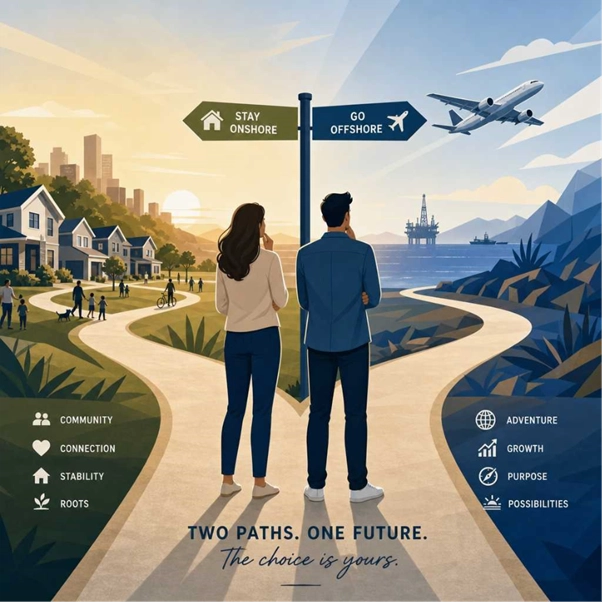
The Australian partner visa process has a reputation for being slow, expensive, and confusing — and that reputation is earned. The Department of Home Affairs reports processing times that can stretch beyond 24 months for some pathways, and a single misstep in documentation can reset your timeline entirely. If you are trying to bring a spouse or de facto partner to Australia, or stay in Australia while your case is assessed, the first and most consequential decision you will make is whether to apply onshore or offshore. This article breaks down both pathways with the clarity that couples making this decision actually need.
Table of Contents
- Onshore vs Offshore: What These Terms Actually Mean
- Subclass 820 Visa: The Onshore Pathway
- Subclass 309 Visa: The Offshore Pathway
- Side-by-Side Comparison of Both Pathways
- Eligibility Requirements You Cannot Ignore
- Processing Times and Government Fees in 2026
- Common Mistakes That Delay or Sink Applications
- How to Decide Which Pathway Is Right for You
- Why Working With a MARA Registered Migration Agent Matters
- Frequently Asked Questions
Quick Takeaways
| Key Insight | Explanation |
|---|---|
| Onshore vs offshore is determined by where you physically are at the time of application | If you are in Australia on a valid visa when you apply, you use the onshore pathway (subclass 820/801). If you are outside Australia, you use the offshore pathway (subclass 309/100). |
| The onshore subclass 820 grants bridging rights immediately | Once you lodge a valid subclass 820 application, you are typically granted a Bridging Visa A, which allows you to remain lawfully in Australia while the case is processed. |
| Both pathways are a two-stage process | You first receive a temporary visa (820 or 309), then after a mandatory two-year assessment period, you become eligible for the permanent visa (801 or 100). |
| Relationships must be genuine and ongoing throughout | The Department assesses relationship authenticity at the temporary stage and again at the permanent stage. Relationships that end before the permanent grant can result in visa cancellation. |
| Government fees exceeded AUD 11,710 as of 2026 | The primary applicant fee for partner visa applications lodged from 1 July 2026 is AUD 11,710, plus additional costs for secondary applicants and health checks. |
| A de facto partner of 12 months qualifies, not just a married spouse | While applying onshore Partner Visa, you do not need to be legally married. A genuine de facto relationship of at least 12 months is sufficient, though registered relationships in certain Australian states may waive this requirement. |
| Working with a MARA registered migration agent significantly reduces refusal risk | Partner visa refusals are frequently caused by incomplete evidence packages or incorrect form submissions. A registered migration agent ensures the file meets Department standards before lodgement. |
Onshore vs Offshore: What These Terms Actually Mean
These terms confuse applicants more than almost anything else in the Australian migration system. The distinction is straightforward: your physical location at the time you lodge the application determines which stream you use. If you are inside Australia on a valid visa when you hit submit, you are an onshore applicant. If you are outside Australia, you are an offshore applicant.
What complicates this is that the word “offshore” does not mean you can never come to Australia during processing. An offshore applicant on a Subclass 309 visa can still visit Australia on a tourist visa while waiting, and once the Subclass 309 is granted, they can enter and live in Australia. The pathway label simply describes where the application is initiated.
A common mistake is assuming that whichever pathway is faster must be the better choice. In practice, the right pathway depends entirely on your current visa status, where your sponsor lives, and your work and family obligations. There is no universally superior option.
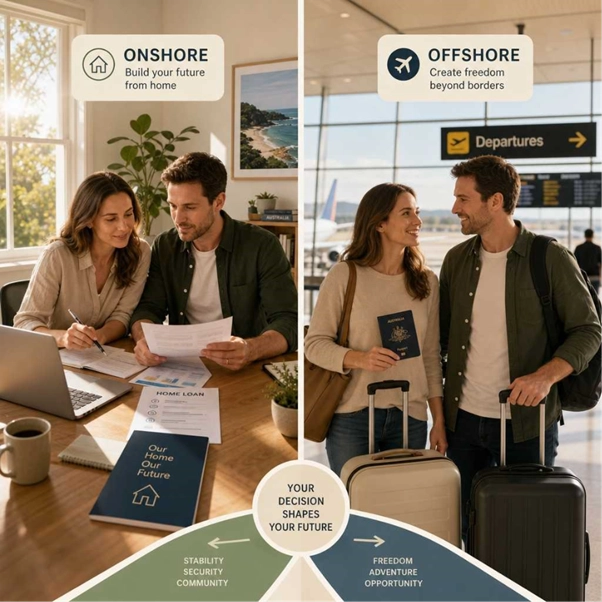
Subclass 820 Visa: The Onshore Pathway
The Subclass 820 visa is the temporary stage of the onshore partner visa. It is lodged while the applicant is physically in Australia and holds a valid substantive visa. That last part matters: if your current visa has expired and you are on a Bridging Visa A or B, or have no valid visa at all, your eligibility situation becomes significantly more complicated.
What Happens After You Lodge a Subclass 820 Application
Once a valid application is lodged, the Department typically grants a Bridging Visa A (BVA) shortly after. This bridging visa allows the applicant to remain in Australia lawfully, work without restriction, and access Medicare while the primary assessment is underway. This is a major practical benefit: the applicant does not need to leave the country during what can be a multi-year wait.
After the temporary 820 visa is granted, the clock starts on the two-year assessment period. At the two-year mark from initial lodgement, the applicant becomes eligible to have the permanent Subclass 801 visa assessed. If the relationship is still genuine and ongoing, the 801 is then assessed based on updated relationship evidence and information. No additional Visa Application Charge (VAC) is payable at this stage — the VAC is a one-time payment made with the initial combined 820/801 application.
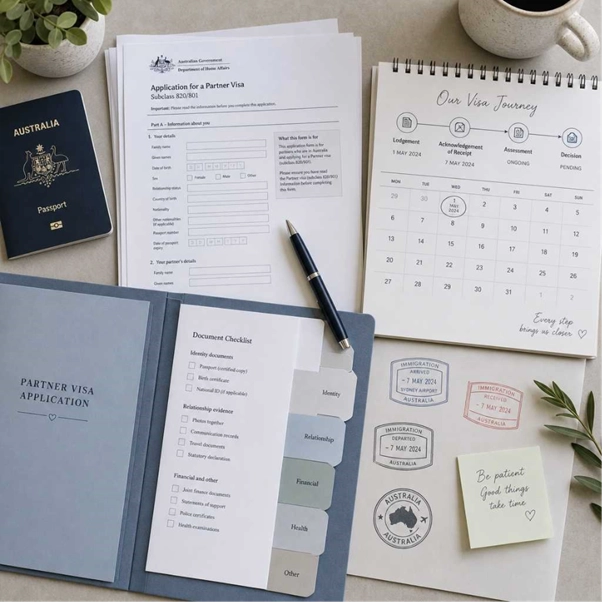
Who Should Use the Onshore Pathway
This pathway suits couples where the overseas partner is already in Australia on a student visa, working holiday visa, temporary work visa, or any other valid substantive visa. It also suits situations where both partners live in Australia and the sponsoring partner is an Australian citizen or permanent resident.
Pro tip: If you are on a visa that is about to expire, lodge the Subclass 820 application before expiry. The bridging visa that activates will keep you lawfully in Australia, but you lose the option if you let your substantive visa lapse first.
Subclass 309 Visa: The Offshore Pathway
The Subclass 309 visa is lodged from outside Australia. It is the pathway used when the partner seeking to move to Australia is currently living overseas and has not been able to come to Australia on a valid visa prior to applying. It is also the default choice for couples in long-distance relationships where one partner is an Australian citizen or permanent resident living in Australia and the other is abroad.
How the Two-Stage Offshore Process Works
Like the onshore stream, the offshore pathway is a two-stage process. The Subclass 309 is the temporary visa, and the Subclass 100 is the permanent visa that follows after the two-year assessment period. Both stages are included in a single application lodged from outside Australia.
Once the Subclass 309 is granted, the applicant can travel to and live in Australia. They can work and study here as well. The grant of the 309 does not mean the applicant must stay in Australia, but most applicants use it to join their sponsor partner and begin building their life together.
The Waiting Period Challenge for Offshore Applicants
The difficult reality of the offshore pathway is that between lodgement and the grant of the Subclass 309, the overseas applicant has no automatic right to come to Australia. They can apply for a visitor visa or use any other valid visa to visit during this period, but they cannot simply enter and stay. For couples separated by distance, this waiting period is genuinely hard.
The data consistently shows that offshore partner visa applications currently face median processing times of 18 to 22 months for the temporary stage, according to Department of Home Affairs processing time data. Some cases take longer, particularly where relationship evidence is thin or identity documents require additional verification.
Side-by-Side Comparison of Both Pathways
The table below compares the two main partner visa pathways on the factors that most directly affect applicants. Use this as a starting reference point, not as a substitute for professional advice tailored to your specific situation.
| Factor | Subclass 820/801 (Onshore) | Subclass 309/100 (Offshore) |
|---|---|---|
| Where you must be at lodgement | Inside Australia on a valid substantive visa | Outside Australia |
| Right to remain in Australia after lodgement | Yes, via Bridging Visa A | No automatic right; must use a separate visa to visit |
| Work rights during processing | Full work rights on Bridging Visa A | No work rights until Subclass 309 is granted |
| Temporary visa granted | Subclass 820 | Subclass 309 |
| Permanent visa granted | Subclass 801 (after two-year assessment) | Subclass 100 (after two-year assessment) |
| Government application fee (2026) | AUD 11,710 (primary applicant) | AUD 11,710 (primary applicant) |
| Medicare access during processing | Yes, on Bridging Visa A | No, until Subclass 309 is granted and applicant is in Australia |
Eligibility Requirements You Cannot Ignore
Both pathways share the same fundamental eligibility criteria. The Australian sponsor must be an Australian citizen, Australian permanent resident, or eligible New Zealand citizen. The applicant must be in a genuine, ongoing relationship with the sponsor — either married or in a de facto partnership of at least 12 months.
Proving the Relationship Is Genuine
The Department of Home Affairs assesses relationship genuineness across four categories: financial aspects, nature of the household, social aspects, and commitment to each other. You need evidence across all four — not just one or two. In practice, the weakest applications are those that provide bank statements but nothing showing shared social life, or those that show cohabitation but no evidence of commitment such as joint future planning.
Strong evidence packages include:
- Joint lease agreements or mortgage documents
- Joint bank account statements
- Photos together across multiple years
- Correspondence between the couple
- Statutory declarations from friends and family
- Evidence of travel together
The more consistent and layered the evidence, the more credible the application.
Health and Character Requirements
All partner visa applicants must undergo a health examination conducted by a Department-approved panel physician. They must also meet character requirements, which typically means providing police clearance certificates from every country they have lived in for 12 months or more in the past 10 years.
Pro tip: Start gathering police clearances from overseas countries as early as possible. Some countries take three to six months to issue these documents, and you can prepare character documents in advance while waiting for your visa application to be lodged.
Processing Times and Government Fees in 2026
The government fee for lodging an Australian partner visa application as of 1 July 2026 is AUD 11,710 for the primary applicant. Secondary applicants aged 18 and over pay AUD 5,860 each, and secondary applicants under 18 pay AUD 2,935 each. These fees are non-refundable once the application is lodged, regardless of outcome.
Beyond the government fee, applicants should budget for:
- Health examination costs (approximately AUD 300-500 per adult depending on location)
- Police clearance fees
- Document translation costs
- Migration agent fees if using professional assistance
“The median processing time for partner visas in the 309 and 820 streams currently sits between 16-27 months for 50-90% of applications, with some complex cases taking 36 months or more.” — Department of Home Affairs, Processing Times Data, 2026.
Processing times are not guaranteed and vary based on application complexity, completeness of the initial submission, and current caseload volumes at the Department. Applications lodged with complete, well-organised evidence packages are processed faster than those that require the Department to issue requests for additional information.
Common Mistakes That Delay or Sink Applications
After reviewing hundreds of partner visa cases across more than two decades of migration practice, the patterns in failed or delayed applications are consistent. The same errors appear repeatedly, and most of them are entirely preventable.
The most damaging mistake is submitting a thin evidence package and assuming the Department will give you the benefit of the doubt. They will not. The burden of proof sits entirely with the applicant. If you cannot demonstrate the four categories of relationship evidence clearly, the application will be refused or delayed with a request for more information, which adds months to your timeline.
A second common mistake is failing to notify the Department of a change of address or contact details during processing. Partner visa cases can take two or more years. If the Department sends a correspondence request and it goes to an old email address, you may miss a critical deadline. The result can be a refusal or a deemed withdrawal of the application.
A third error, specific to onshore applicants, is travelling outside Australia without a Bridging Visa B. If you hold a Bridging Visa A and leave Australia without first obtaining a BVB, your bridging visa ceases and you may not be able to re-enter to continue the application. This catches people off guard, particularly those with family emergencies overseas.
How to Decide Which Pathway Is Right for You
The decision between onshore and offshore is usually made for you by your circumstances, not by preference. If you are already in Australia on a valid visa, the onshore pathway is almost always the correct choice because it allows you to remain here during processing. If you are overseas with no current Australian visa, the offshore pathway is your route.
Where genuine complexity arises is in edge cases. What if you are in Australia on a visa that is about to expire and you cannot extend it? What if your relationship started while you were on a student visa and you have now returned to your home country? What if your sponsor is an Australian permanent resident but not yet a citizen, and there are questions about their eligibility to sponsor? These scenarios require individual assessment, not a generic checklist.
At TerraOz Migration, the initial consultation process exists precisely to map out these scenarios. With over 20 years of experience handling partner visa cases, the team can identify which pathway is appropriate and flag any complications before lodgement, not after. A MARA registered migration agent is not a luxury for partner visa applications. Given the non-refundable fees and the multi-year timeline, getting the pathway right at the start is essential.
Why Working With a MARA Registered Migration Agent Matters
A MARA registered migration agent is a practitioner who has passed the Graduate Certificate in Australian Migration Law and Practice, is registered with the Office of the Migration Agents Registration Authority, and is bound by a code of conduct that protects clients. This is not the same as a community worker, or a friend who has successfully obtained their own visa.
Only MARA registered agents and Australian legal practitioners are legally authorised to provide migration advice for a fee in Australia. Anyone else giving paid migration advice is acting unlawfully, and advice from unlawful practitioners has no professional accountability behind it.
The difference between a well-prepared partner visa application and a poorly prepared one can be the difference between a 20-month wait and a 36-month wait, or between approval and refusal. The Department’s processing times clearly show that complete, well-evidenced applications are prioritised. A MARA agent structures the evidence package to meet the Department’s assessment criteria, completes the complex forms accurately, and manages correspondence with the Department throughout the process.
TerraOz Migration operates on transparent fixed-fee pricing, which means there are no surprise costs mid-application. The firm’s 98% client satisfaction rate and 1,000-plus successful visa approvals are a direct reflection of what consistent professional preparation delivers across partner visa and skilled migration cases alike.
Frequently Asked Questions
Can I switch from an offshore to an onshore partner visa application after lodgement?
No. Once you have lodged an offshore (subclass 309) application, you cannot convert it to an onshore (subclass 820) application. These are separate visa subclasses with different legislative bases. If your circumstances change significantly after lodgement, you would need to withdraw the offshore application and lodge a new onshore application, which means paying the government fee again and restarting the timeline. This is exactly why getting the pathway right before lodgement is so important.
Does my de facto relationship need to be registered to qualify for the partner visa?
No, registration is not mandatory at the national level. However, if you and your partner have registered your relationship through a state or territory relationship registry in Australia, this can waive the 12-month cohabitation requirement. Unregistered de facto relationships are fully eligible, but you must demonstrate 12 months of continuous cohabitation prior to application and provide strong evidence of the relationship across all four assessment categories.
What happens if I travel outside Australia while my subclass 820 application is being processed?
If you hold a Bridging Visa A and travel outside Australia without first obtaining a Bridging Visa B, your bridging visa will cease when you depart. You will then be unable to return to Australia to continue the application unless you obtain another valid visa. Before any international travel during the partner visa processing period, confirm your bridging visa conditions and obtain a BVB if needed. This is a straightforward step that is frequently overlooked.
How long does the Australian partner visa process take from start to permanent visa grant?
The full process from lodgement to permanent visa grant typically takes between two to three years. The first stage, receiving the temporary visa (subclass 820 or 309), currently takes 16-27 months for most applications. Then there is a mandatory two-year assessment period before the permanent visa (subclass 801 or 100) can be granted. Total timelines can be shorter or longer depending on application complexity and how the Department’s workload trends.
Can the Australian sponsor be a permanent resident rather than a citizen?
Yes. Australian permanent residents are eligible to sponsor their partner for a partner visa. However, there is an important difference: if the sponsor is a permanent resident rather than a citizen, there may be additional considerations around the sponsor’s own residency obligations and whether they meet the eligibility criteria as a sponsor. A MARA registered migration agent should review the sponsor’s status as part of the initial assessment.
Is there any way to speed up the partner visa processing time?
There is no fast-track or priority processing option for standard partner visa applications. The most effective way to avoid delays is to lodge a complete application with a comprehensive evidence package, respond promptly to any requests for additional information from the Department, and ensure all health and character documents are obtained and submitted without delays. Applications that require the Department to send multiple requests for information consistently take longer than those that are complete at lodgement.
What is the difference between a partner visa and a prospective marriage visa?
A prospective marriage visa (subclass 300) is for couples who are engaged but not yet married at the time of application. It allows the overseas partner to enter Australia to marry their sponsor within nine months of visa grant. After the marriage, the couple can apply for a partner visa (subclass 820/801). The prospective marriage visa is not the same as the partner visa and has its own eligibility requirements and processing times. If you are already married or in a de facto relationship, the partner visa is the correct pathway.
If you have gone through the partner visa process or are currently navigating it, share what aspect of the onshore versus offshore decision you found most confusing. Your experience could help others in the same situation.
References
- Australian Department of Home Affairs official immigration portal with visa subclass information, processing times, and application requirements
- Office of the Migration Agents Registration Authority, the official register and regulatory body for MARA registered migration agents in Australia
- Australian Government legislation database including the Migration Act 1958 and Migration Regulations 1994 governing partner visa requirements
- Australian Bureau of Statistics data on migration, overseas-born population, and international partner demographics in Australia
- Commonwealth Ombudsman guidance on migration agent complaints and rights of visa applicants in Australia