
MARA Registered Migration Agent: Why It Matters
Every year, thousands of people lodge Australian visa applications without qualified help, and a significant portion of those applications fail, get delayed, or are refused outright. The difference between a successful visa outcome and a costly rejection often comes down to one factor: whether you worked with a MARA registered migration agent or took a gamble on unregistered advice. This article explains exactly what MARA registration means, how the Office of the Migration Agents Registration Authority (OMARA) protects you, and why choosing a registered Australian immigration consultant is not optional if you want a reliable outcome.
Table of Contents
- What Is a MARA Registered Migration Agent?
- How OMARA Works and Who It Regulates
- Why MARA Registration Matters for Your Visa Application
- The Real Risks of Using Unregistered Migration Agents
- MARA Agent vs. Immigration Lawyer vs. DIY Application
- How to Verify a Migration Agent Is MARA Registered
- What to Expect When Working With a MARA Agent
- Frequently Asked Questions
Quick Takeaways
| Key Insight | Explanation |
|---|---|
| MARA registration is mandatory for paid migration advice in Australia | Anyone providing immigration assistance for payment must be registered with OMARA or be a practicing Australian legal professional. There are no exceptions. |
| OMARA maintains a public register you can search right now | The Department of Home Affairs website hosts a live searchable register of all current and former registered migration agents in Australia. |
| Unregistered agents cannot be disciplined or held accountable | If an unregistered agent takes your money and files a botched application, OMARA has no authority over them and you have very limited legal recourse. |
| MARA agents must complete Continuing Professional Development (CPD) each year | Registration requires annual CPD hours to stay current with changes to migration law, ensuring your agent’s knowledge is not outdated. |
| A refused visa can trigger a waiting period or a ban on future applications | Visa refusals are not just setbacks. Depending on the visa subclass, a refusal can bar you from applying again within a specified period or permanently affect your character assessment. |
| Registered agents are bound by a Code of Conduct | OMARA’s Code of Conduct requires agents to act in your best interest, keep your information confidential, and provide honest assessments of your prospects. |
| TerraOz Migration is MARA-registered with 20-plus years of active experience | With more than 1,000 approved visas and a 98 percent client satisfaction rate, TerraOz demonstrates what a registered consultancy actually delivers in practice. |
What Is a MARA Registered Migration Agent?
A Registered Migration Agent is a professional who has met the legal requirements set by the Office of the Migration Agents Registration Authority (OMARA) to provide immigration assistance in Australia for payment. Registration is not voluntary: it is a legal requirement under the Migration Act 1958 and the Migration Agents Regulations 1998 for anyone (other than exempt persons and legal practitioners) who gives immigration assistance for a fee. If someone charges you for visa advice or assistance and is neither an OMARA‑registered migration agent nor a practising Australian lawyer, they are committing an offence under Australian law.
To become registered, most new agents must complete an approved Graduate Diploma in Australian Migration Law and Practice (previously a Graduate Certificate), pass the independent Capstone assessment, and satisfy OMARA’s character, competency and other eligibility checks (including age, citizenship/PR status, English, AFP police check and professional indemnity insurance). This is not a quick or informal online program: the Graduate Diploma is a formal, postgraduate qualification typically delivered over one year of full‑time study (or equivalent part‑time), and covers Australian migration law, visa subclasses, professional conduct, ethics and client management.
OMARA registration allows an agent to provide commercial immigration assistance (for payment); OMARA also recognises non‑commercial or volunteer immigration assistance in limited circumstances for “exempt persons”, but these individuals are still subject to the Migration Act and cannot charge fees unless they meet the registration or legal practitioner requirements.
In practice, MARA registration acts as a baseline guarantee. It does not guarantee the agent is experienced or excellent at their job, but it does guarantee they have the minimum legal knowledge, are bound by a formal Code of Conduct, carry professional indemnity insurance, and can be reported to OMARA if they behave improperly. That baseline protection simply does not exist with unregistered operators.
For visa categories such as skilled migration, partner visas, employer-sponsored visas, and regional visas, the rules change frequently. A registered migration agent is required to complete annual Continuing Professional Development, so their knowledge stays current with the latest policy updates from the Department of Home Affairs.
How OMARA Works and Who It Regulates
The Office of the Migration Agents Registration Authority (OMARA) is the regulatory body that oversees registered migration agents in Australia. It sits within the Department of Home Affairs and has the authority to register agents, investigate complaints, impose sanctions, and cancel or suspend registrations. OMARA is the enforcement mechanism that gives MARA registration its teeth.
OMARA maintains a public register of all currently registered migration agents. Each entry shows the agent’s registration number, registration status, and the date their registration expires. If an agent’s registration has lapsed or been cancelled, that is visible on the register. This transparency is deliberate. It means any client can check an agent’s status before handing over a single dollar.
When a complaint is lodged against a registered agent, OMARA has a formal investigation process. Sanctions available to OMARA include formal cautions, conditions on registration, suspension, and permanent cancellation. Agents who have been cancelled are also listed on the public register, which prevents them from quietly relaunching under a slightly different name.
OMARA does not regulate Australian legal practitioners, who are separately governed by state and territory legal bodies. A migration lawyer practicing under their legal practicing certificate is also authorised to provide migration advice, and they are accountable to their state law society or bar association. Everyone else providing paid migration assistance is either registered with OMARA or operating illegally.
Pro tip: Before your first consultation with any migration consultant, search the OMARA register on the Department of Home Affairs website and confirm their registration number matches the one on their business materials. This takes under two minutes and eliminates all risk of engaging an unregistered operator.
Why MARA Registration Matters for Your Visa Application
The Australian immigration system is genuinely complex. The Department of Home Affairs administers over 100 visa subclasses, each with distinct eligibility criteria, documentation requirements, health and character obligations, and processing pathways. The rules governing skills assessments for skilled migration alone span multiple assessing authorities with different standards for different occupations. Getting this wrong is easy, and the consequences are severe.
A registered migration agent in Australia brings three things that unregistered operators cannot legally or practically provide. First, they bring verified knowledge. Their qualification and CPD obligations mean they understand current law, not what the law was three years ago when they last looked at it. Second, they bring accountability. Their registration depends on acting professionally and ethically. If they fail you, you have a formal complaint mechanism. Third, they bring professional indemnity insurance, which means if their error causes you a direct loss, there is an insurance mechanism to seek compensation.
For partner visa applicants, the stakes are particularly high. The partner visa process involves two stages, extensive personal documentation, relationship evidence requirements, and biometrics. A poorly prepared application can result in a request for further information that delays your case by months, or an outright refusal that sends you to the Administrative Appeals Tribunal. At TerraOz Migration, the team has processed partner visas for clients from dozens of countries and knows exactly where applications get tripped up: incomplete statutory declarations, mismatched timelines in relationship evidence, and missing financial interdependence documents are the most common failure points.
For skilled migration, the consequences of using a bad agent are equally serious. If an agent claims skills points you do not legitimately hold, or fails to disclose a previous visa refusal, the Department of Home Affairs can find those discrepancies and your application can be refused on character or integrity grounds. A MARA agent is legally prohibited from making false representations on your behalf. That constraint protects you as much as it protects the system.
“The Migration Agents Registration Authority scheme exists to protect consumers of migration assistance by providing a system of registration, conduct regulation, and complaint handling for migration agents.” - Department of Home Affairs, Australian Government
The Real Risks of Using Unregistered Migration Agents
Unregistered migration agents are not simply less qualified. They are operating illegally, and the risks they create for their clients are concrete and documented. OMARA and the Department of Home Affairs regularly publish warnings about unregistered operators, and Australian Border Force has prosecuted individuals for providing unlawful immigration assistance. The human cost of these prosecutions is real: clients who paid for help and ended up with refused visas, loss of status, or removal from Australia.
A common mistake is assuming that someone who has helped a friend or relative with a visa successfully is therefore competent to help you. Migration law changes constantly. A strategy that worked two years ago may be invalid today. A registered agent has CPD obligations precisely because outdated knowledge causes harm. An unregistered operator has no obligation to know anything beyond what they picked up informally.
The financial risk is also significant. Unregistered agents frequently charge fees comparable to or higher than registered agents, then deliver no refund when the application fails or when they simply disappear. Because they are not regulated, there is no industry body to complain to, no professional indemnity insurance to claim against, and limited civil law options for recovering money paid to someone operating in an underground market.
There is also a secondary damage effect that many clients do not consider. A visa refusal creates a formal record with the Department of Home Affairs. Future visa applications require you to disclose previous refusals. A refusal caused by a bad agent therefore affects every visa application you make for the rest of your life. The upfront saving of using a cheap or unregistered operator can translate into a permanent disadvantage in your migration history.
Pro tip: If an agent offers to guarantee your visa approval or claims to have special connections inside the Department of Home Affairs, stop the conversation immediately. No legitimate MARA agent makes those claims. Visa decisions are made by government officers under law, and any agent claiming otherwise is a red flag.
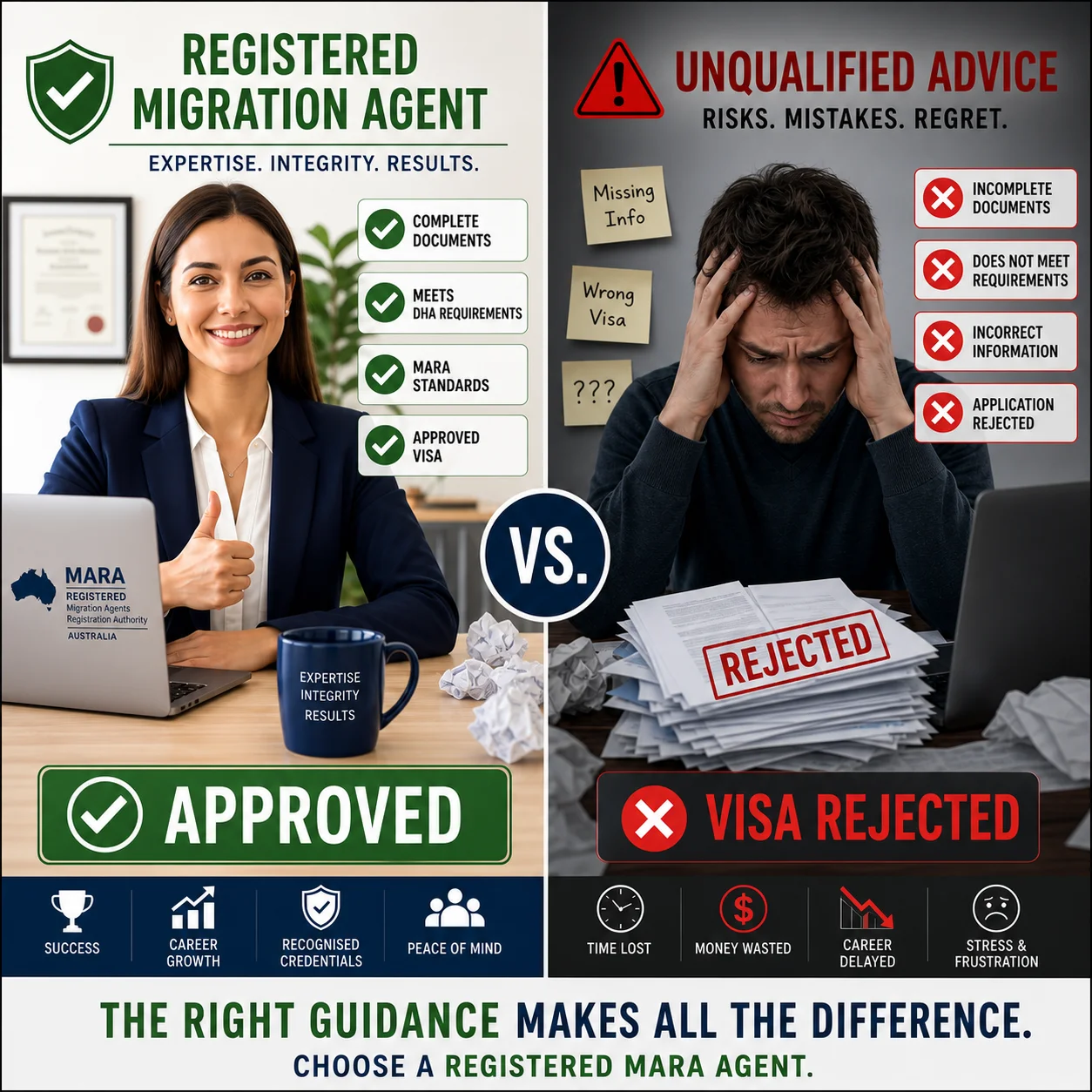
MARA Agent vs. Immigration Lawyer vs. DIY Application
Applicants often ask whether they should use a MARA agent, hire an immigration lawyer, or lodge their application themselves. Each path has real trade-offs. The table below is a practical comparison based on what actually happens in these scenarios, not a theoretical exercise.
| Factor | MARA Registered Migration Agent | Immigration Lawyer | DIY Application |
|---|---|---|---|
| Legal authority to provide paid advice | Yes, under OMARA registration | Yes, under legal practicing certificate | Not applicable (no advice given) |
| Regulatory accountability | OMARA Code of Conduct, formal complaints process | State law society or bar association | None |
| Cost range for standard partner visa | Typically AUD 2,000 to AUD 5,000 in professional fees | Typically AUD 4,000 to AUD 10,000 or more | Government fees only, no professional fees |
| Best suited for | Most visa types including skilled, partner, employer-sponsored, student, and regional visas | Complex cases involving litigation, character issues, or merits review at the AAT | Simple, straightforward visitor visa applications where eligibility is clear-cut |
| Risk of application error | Low when working with an experienced registered agent | Low, but communication can be more formal and less hands-on | High, particularly for document-heavy or points-tested visa subclasses |
| Ongoing case management | Typically included as part of the service package | Billable by the hour in most firms | Entirely self-managed |
The data consistently shows that for the majority of visa types, a MARA registered agent delivers the best combination of expertise, accessibility, and cost. Immigration lawyers are essential when a case reaches litigation or involves complex character or fraud allegations. DIY applications carry the highest risk for any visa that requires points testing, skills assessment coordination, or multi-stage processing.
How to Verify a Migration Agent Is MARA Registered
Verifying a migration agent’s registration status takes less than two minutes and should be your first step before any engagement. The Department of Home Affairs maintains a live public register of all registered migration agents. You can search by name, registration number, or location. A valid registration entry will show a current registration status and a registration expiry date in the future.
When you contact a registered agent, they are required to provide you with a written statement of their registration details before they provide any migration assistance. This includes their full name, registration number, and the address of their business. If an agent refuses to provide this or becomes evasive when you ask for their registration number, that is a serious warning sign.
At TerraOz Migration, registration details are provided transparently from the first point of contact. The firm’s MARA registration number is displayed on their website and all client-facing documentation. This is the standard that every registered agent should meet. If the agent you are speaking to does not do this, the OMARA register will tell you why.
It is also worth checking the agent’s registration history, not just their current status. The OMARA register shows historical registration records. An agent who has had their registration suspended in the past, or who has been subject to OMARA sanctions, will have that history visible. A clean, uninterrupted registration history spanning multiple years is a positive indicator of professional conduct.
What to Expect When Working With a MARA Agent
Working with a professional MARA registered migration agent is a structured process, not a single phone call. Understanding what a legitimate engagement looks like helps you identify whether the agent you are considering operates to a professional standard.
The first step is a formal initial consultation. A registered agent will assess your eligibility for the visa you are interested in, identify any risks or issues in your profile, and give you an honest assessment of your prospects. This assessment should be based on the specific facts of your situation, not a generic positive sell. If an agent tells everyone they consult that their application looks great, that is not an assessment, that is a sales pitch.
Frequently Asked Questions
What does MARA stand for in Australian immigration?
MARA stands for the Migration Agents Registration Authority. It is the regulatory framework, administered through the Office of the Migration Agents Registration Authority (OMARA), that governs who can legally provide paid migration assistance in Australia. Registration under MARA is required under the Migration Act 1958.
Is a MARA registered agent the same as an immigration lawyer?
No, they are different but both are legally authorised to provide paid migration assistance. A MARA registered agent holds a graduate-level qualification in migration law and practice and is regulated by OMARA. An immigration lawyer holds a legal practicing certificate and is regulated by their state or territory law society. For most standard visa applications, a registered migration agent is the appropriate choice. For matters involving litigation or complex legal disputes, an immigration lawyer may be more suitable.
How do I check if my migration agent is currently MARA registered?
Search the public register on the Department of Home Affairs website and find Registered Migration Agent. Then using the agent’s name or registration number, the register shows current registration status, expiry date, and any historical sanctions. If the agent’s registration is expired or cancelled, do not proceed with them. A legitimate registered agent will proactively share their registration number with you before you engage their services.
Can a MARA agent guarantee my visa will be approved?
No. No MARA registered migration agent can legally or ethically guarantee a visa outcome. Visa decisions are made by officers of the Department of Home Affairs based on migration law and the evidence before them. Any agent who guarantees approval is making a false claim and may be in breach of the OMARA Code of Conduct. What a registered agent can do is maximise the strength of your application and ensure it complies fully with legal requirements.
What should I do if I have already used an unregistered agent and my visa was refused?
You have a few options depending on the visa subclass and the timeframes involved. You may be able to apply for merits review at the Administrative Appeals Tribunal or lodge a new application. The most important step is to engage a MARA registered agent immediately to assess your situation. At TerraOz Migration, the team regularly assists clients who are recovering from poor outcomes caused by unregistered or incompetent operators, and the first step is always an honest assessment of what options remain open.
Why is the OMARA register important to check before hiring an agent?
The OMARA register is the only authoritative source of registration status. An agent’s website, business card, or verbal claim cannot substitute for a live check on the official register. Registration can be cancelled or suspended at any time, and the register reflects that in real time. Checking the register takes two minutes and eliminates the risk of engaging someone who is no longer authorised to provide migration assistance.
Does TerraOz Migration hold current MARA registration?
Yes. TerraOz Migration is a MARA-registered migration consultancy with over 20 years of experience in Australian immigration. Their registration details are available on request and searchable on the OMARA public register. With more than 1,000 approved visas across skilled migration, partner visas, employer-sponsored visas, student visas, and regional visas, TerraOz operates as a full-service registered consultancy from initial consultation through to visa grant.
Let us know what questions you still have about choosing the right Australian immigration consultant.
References
- Australian Government Department of Home Affairs, official source for migration agent registration rules and the OMARA public register
- Federal Register of Legislation, the authoritative source for the Migration Act 1958 and Migration Agents Regulations 1998
- Forbes, reporting on international migration trends and the economic value of professional immigration advice
- Statista, statistical data on Australian visa applications, approval rates, and migration volumes by visa subclass
- Administrative Appeals Tribunal of Australia, official information on merits review processes for refused visa applications